Pharmaceuticals and cosmetics
Serialisation, unique identifiers and pack coding, where a failed code is a rejected batch.
Serialisation changed the requirement
Under the Falsified Medicines Directive (2011/62/EU) and Delegated Regulation (EU) 2016/161, prescription medicine packs sold in the EU carry a unique identifier in a 2D data matrix, together with the product code, serial number, batch and expiry date.
That is a different job from printing a date. A data matrix has to be readable by a verification system every time, at every point in the supply chain. A code that is 95% readable is not a good code — it is a batch that will generate exceptions somewhere between your line and the pharmacy.
What that means for the equipment
Resolution stops being a preference and becomes the specification. Small-character coding technology is not designed to produce a reliably gradeable data matrix at pack scale.
Verification matters as much as printing. A print-and-check arrangement, where a vision system reads back what was printed and rejects what fails, is standard practice rather than an upgrade.
Cosmetics sit slightly differently — the regulatory burden is lighter — but the appearance requirement is heavier. A code on a premium container is scrutinised in a way that a code on a case is not.
What usually fits
High-resolution thermal or piezo inkjet for cartons and pack surfaces, where a gradeable 2D code is the output. Continuous inkjet still has a place for simpler date coding on primary containers such as ampoules, tubes and plastic bottles.
Worth checking
Is the code human-readable, machine-readable, or both?
Is there a verification step, and does it reject or only alert?
What substrate does the identifier actually land on — coated carton, foil, plastic?
Recommended printers
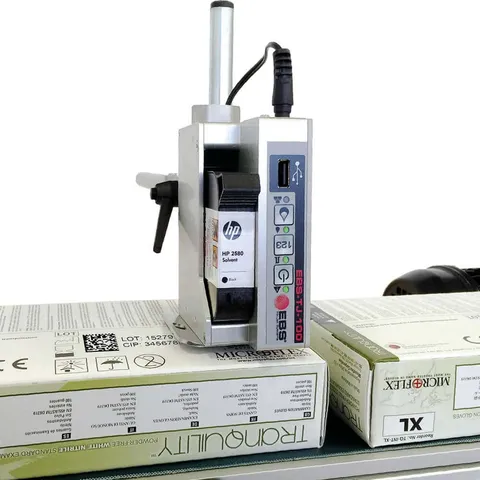
EBS-TJ-100
HP bubble-jet high-resolution printer, print height up to 12.5 mm, speed up to 90 m/min.
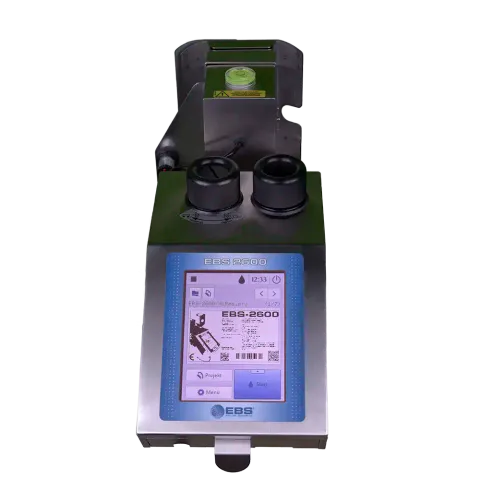
EBS-2600
High-resolution piezo printer for absorbent surfaces, 15 W maximum power draw.
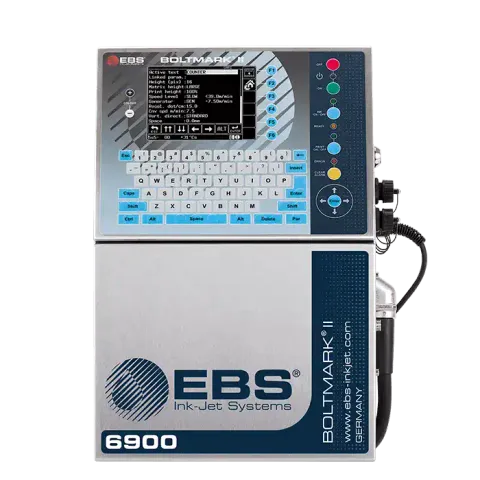
EBS-6900
Continuous inkjet coding for fast lines, with the full option set.